An agrivoltaic approach provides an array of benefits
The University of Minnesota Morris and the West Central Research and Outreach Center are partnering on a new agrivoltaic approach that provides renewable energy, stimulates the local economy, and offers unique research opportunities.

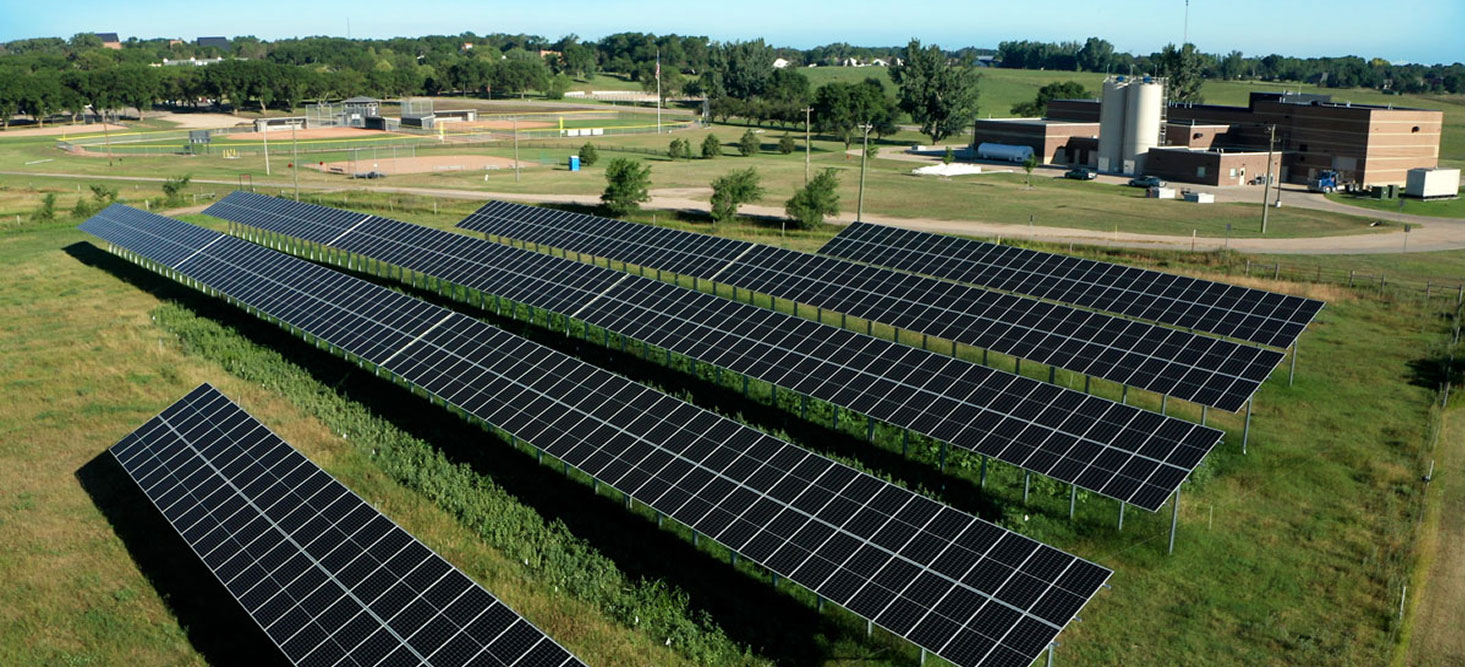
Along Highway 59 in Morris, MN, cattle graze peacefully under rows of solar panels. The eye-catching setup isn’t just a novel sight—it’s a groundbreaking experiment that’s generating clean power, supporting local agriculture, and energizing the rural economy.
In collaboration with the College of Food, Agricultural and Natural Resource Sciences’ West Central Research and Outreach Center (WCROC), the University of Minnesota Morris has developed one of the most unique solar arrays in the Midwest.
“We didn’t want to just put up solar panels. We wanted to think creatively about how to use the land. This was about showing that solar and agriculture don’t have to compete—they can work together.”
Bryan Hermann, University of Minnesota Morris vice chancellor for finance and facilities
The array, with solar panels elevated eight feet off the ground, was intentionally designed to allow cattle to graze beneath it. This “agrivoltaic” approach—using land simultaneously for agriculture and solar power—is both an efficient use of space and cooperation between clean energy and traditional farming.
Using a ground-mounted solar panel system in a dairy setting provides shade to dairy cows during extreme heat events and gives farmers an alternative means of income. Agrivoltaics is one way producers might be able to become less dependent on fossil fuels, lower production costs, increase land efficiency, improve forages and crops for use by dairy cattle, and increase milk production and health in dairy cows. The WCROC dairy operation milks 275 cows twice daily and is representative of a mid-size Minnesota dairy farm.

A living lab
Funding for this project was provided by the Minnesota Environment and Natural Resources Trust Fund as recommended by the Legislative-Citizen Commission on Minnesota Resources (LCCMR). With this funding, the array was expanded in 2024 to 500 kilowatts, making it the largest dairy agrivoltaics field in the Upper Midwest. Depending on the day, the array could provide up to half the energy needed to power the Morris campus.
In addition, the expanded array provides an opportunity for unique research and community engagement. Contractors, farmers, and policymakers from across the state have taken notice, calling officials at the University of Minnesota Morris and WCROC to ask how they did it—and how they might do the same.
Professor of Dairy Management Brad Heins and others at WCROC have conducted research that shows cows grazing under solar panels experience less heat stress, which is a major concern in dairy production. In a recent study, researchers found that cows under the panels were about a degree Fahrenheit cooler than cows in direct sunlight. Cooler body temperatures could lead to increased milk production.
“That might not sound like a lot, but from a cow’s perspective, that’s a lot,” Heins says.
The team also identified which grasses and legumes thrive in the dappled light of the panels—useful data for farmers looking to maximize pasture health alongside energy production.
“We want this to be a living lab. This is about helping rural communities discover their place in the clean energy future.”
Troy Goodnough, sustainability director at the University of Minnesota Morris

Supporting the local economy
But the impact goes beyond energy. The project also supports the local and rural economy by keeping dollars in-state. Minnesota has no oil, natural gas, or coal, says Eric Buchanan, director of renewable energy at WCROC, so generating power locally creates economic resilience.
“If you're not buying coal from Wyoming or gas from North Dakota, you're spending that money right here in Minnesota,” Buchanan says. “It supports local jobs, local infrastructure, and keeps those dollars circulating in rural communities.”
That economic value has made solar easier to accept in areas where agriculture has long been the area's economic engine. For many, the idea of solar replacing farmland is a nonstarter. But innovative projects, such as the one in Morris, may shift perspectives.


